
Inline QC Checkpoints in Apparel Sewing: Inspector Guide
1747 words
Inline quality control during sewing is the single most cost-effective checkpoint in garment manufacturing: a defect caught at the operator's machine costs roughly one-tenth of what the same defect costs at final inspection, because one fault found late means the entire bundle behind it is suspect. For a 500-unit menswear order running across 18–25 sewing days, a competent inline QC checkpoint system checks three things at every station — stitch formation, measurement against the spec sheet, and visual conformance to the approved sample — and it does so at three fixed points: the first bundle, the midpoint, and final assembly.
Buyers who understand these checkpoints can read a factory's QC report and know whether the inspection was real or decorative. GorgeousBen operates inline QC on every sewing line for wholesale and private-label menswear orders, and this guide breaks down exactly what inspectors look for, stage by stage.
Why Inline QC Beats End-of-Line Inspection

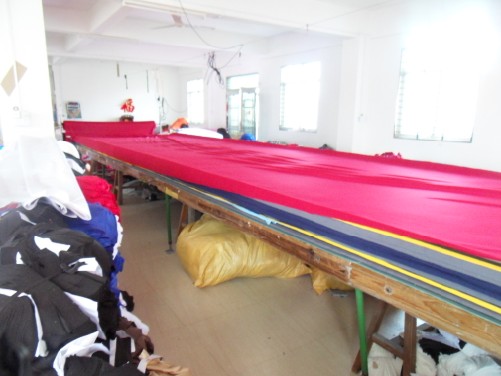
GorgeousBen sewing floor — inline QC inspectors check bundles at three fixed points during production, not only at the end.
The apparel industry's standard quality model is AQL 2.5 (Acceptable Quality Level), which statistically inspects a sample of finished garments — typically 10% of an order of 500 or more. But AQL 2.5 only catches problems after the whole batch is sewn. If a collar point was misaligned starting at piece 1, AQL finds it at piece 500, and now all 500 need rework or downgrade. Inline QC catches the same fault at piece 3, and the correction is applied to pieces 4 through 500 before they are made.
The cost ratio is striking. Industry benchmarks from the Asian Productivity Organization estimate that a defect found at final inspection costs 8–12 times more to fix than one caught at the sewing station, because late-stage rework involves unpicking finished seams, re-pressing, and re-packing. A fault found before the garment leaves the operator's table is fixed in minutes. This is the economic logic behind every garment quality control checkpoint.
Checkpoint 1: First Bundle Approval (First 10–15 Pieces)
The first bundle that comes off each sewing station is the most important inspection event of the entire run. An inspector — usually the line supervisor or a dedicated QC — checks these pieces against the approved pre-production sample and the tech pack measurement chart. If the first bundle passes, the operator continues; if it fails, the station is stopped and the pattern, machine setting, or operator instruction is corrected before more pieces are produced.
Cut bundles arrive at the sewing line tagged by size and colour — the first bundle at each station receives the strictest inspection.
At this checkpoint the inspector verifies:
| Inspection item | What the inspector checks | Tolerance |
|---|---|---|
| Stitch density (SPI) | Stitches per inch against tech pack spec | ±2 SPI |
| Seam allowance | Distance from stitch line to fabric edge | ±2 mm |
| Measurement (critical points) | Chest, waist, sleeve length, hem, collar | ±0.5 cm (grades 1–2) ±1.0 cm (grades 3+) |
| Stitch formation | No skipped stitches, thread breaks, or looped seams | Zero defects |
| Visual conformance | Match to approved sample: colour, shade, component alignment | No deviation |
The first-bundle checkpoint is where factories separate themselves. A trader with no production floor may skip this step entirely — they cannot inspect what they do not control. A real manufacturer stops the line. If your supplier cannot describe their first-bundle inspection process in two sentences, that is a signal to audit the floor in person.
Checkpoint 2: Mid-Point Inspection (50% of Order Complete)
When roughly half the order has been sewn, a second inspection wave checks for drift. Operator fatigue, needle wear, tension changes, and fabric roll variation all cause gradual shifts in quality that are invisible piece by piece but detectable across a sample of 30–50 garments. The inspector pulls a random sample from each size and colour, lays them flat, and remeasures the critical points from the tech pack.
Common mid-point findings include:
- Measurement drift — collar width or hem length creeping ±3–5 mm from the first bundle, usually caused by thread tension or fabric feed changes. The inspector flags the affected size range and the operator recalibrates.
- Shading between rolls
- Skip stitches on overlock seams — a needle starting to burr will produce intermittent skipped stitches that are invisible to a quick visual check but show up when the seam is pulled. Replacing a needle costs 30 seconds; finding skip stitches at final AQL costs hours.
- Component mismatch — a button supplier shipped a slightly different dye lot, or a zipper pull changed finish. Mid-point is the last chance to catch this before the garments enter final assembly.
The mid-point sample size is typically 10% of completed units, selected at random from each size and colour combination. For a 500-unit order with 4 sizes and 2 colours, that means 4–6 pieces per size-colour cell — enough to catch systematic drift without stopping the line.
Checkpoint 3: Final Assembly and Pre-Packing QC

Final assembly QC at GorgeousBen — garments are measured, pressed, trimmed, and AQL-inspected before packing into export cartons.
After sewing is complete, garments move to finishing: thread trimming, buttoning, pressing, and measurement verification. This is the last inline checkpoint before the AQL sample is pulled. The inspector checks every garment for:
- Thread trimming — no loose thread ends longer than 3 mm on any seam, buttonhole, or bartack.
- Pressing quality — seams are flat, no shine or scorch marks, collar rolls are symmetrical, plackets are straight.
- Label placement — care label, brand label, and size label are sewn in the correct position and orientation per the tech pack. A mis-positioned label is the most common cause of buyer rejection in private-label orders.
- Final measurement — the full critical-point measurement chart is re-verified on a random sample, typically 10% of the batch, to catch any drift that survived the mid-point check.
Only after this checkpoint does the batch enter the formal AQL 2.5 inspection, where an independent inspector (factory QC or a third-party agency) pulls a statistical sample using the ISO 2859-1 / ANSI/ASQ Z1.4 sampling plan. For a 500-unit lot at AQL 2.5, the sample size is 50 pieces with an acceptance number of 3 — meaning 3 defects are allowed, and the lot is rejected at 4. At AQL 4.0 (used for less critical items), the acceptance number rises to 7 for the same sample size.
Defect Classification: Critical, Major, Minor
Not every defect is equal, and inline QC inspectors classify them to decide whether to stop the line. Understanding this system helps buyers read QC reports correctly:
| Defect class | Definition | Examples | Action |
|---|---|---|---|
| Critical | Could harm the user or violate regulatory requirements | Sharp needle left in garment; flammability failure; choking-hazard button | Stop line immediately; 100% inspection of affected lot |
| Major | Visible defect that affects appearance, fit, or function; would cause a consumer to return the garment | Measurement out of tolerance; skipped stitches on main seam; shading mismatch; twisted collar | Rework the piece; flag the operator; check the next 10 pieces |
| Minor | Small imperfection that does not affect wear or appearance at normal viewing distance | Loose thread end under 3 mm; tiny fabric slub within tolerance; slight pressing wrinkle | Repair at finishing; do not count toward AQL rejection |
A well-run inline QC system catches major defects at the sewing station and minor defects at finishing. Critical defects should never reach final inspection — if they do, the entire quality system has failed and the line must be audited from scratch.
What Buyers Should Ask a Supplier About Their QC Process
GorgeousBen Fashion is a menswear manufacturer with 20+ years of OEM/ODM experience, producing jackets, shirts, trousers and casual wear for wholesale and private-label programmes. When evaluating any apparel supplier, ask these four questions to gauge whether their inline QC is real:
- "Who inspects the first bundle at each station, and what happens if it fails?" — The answer should name a person (line supervisor, QC inspector) and describe a stop-the-line response. If the answer is vague, the checkpoint does not exist.
- "What is your mid-point sample size and measurement tolerance?" — A real factory will cite specific numbers: 10% sample, ±0.5 cm tolerance for grade 1–2, ±1.0 cm for larger grades. A trader will not know.
- "Which AQL level do you use, and what was your last rejection rate?" — AQL 2.5 is standard for menswear; a factory that tracks its own rejection rate is one that uses QC data to improve, not just to pass inspection.
- "Can I see a recent QC report?" — A factory with a real QC system can produce a dated, itemised report within minutes. A factory that cannot is buying from someone else and has no floor to inspect.
To request a sample QC report or schedule a production-floor audit, contact the GorgeousBen team or browse the product catalogue to see the quality standards applied to every order.
Frequently Asked Questions
What is inline QC in garment manufacturing?
Inline QC is quality inspection performed during the sewing process — not after the batch is finished. Inspectors check the first bundle at each station, pull a mid-point sample at roughly 50% completion, and verify final assembly before AQL sampling. The goal is to catch defects at the source, where rework costs one-tenth of end-of-line inspection.
What AQL level is used for apparel inspection?
AQL 2.5 is the industry standard for most menswear and casual apparel. For a 500-unit lot, this means a sample of 50 pieces with an acceptance number of 3 — the lot passes if 3 or fewer major defects are found, and is rejected at 4. AQL 4.0 is used for less critical categories, allowing 7 defects in the same sample size.
How many QC checkpoints should a garment factory have?
A competent cut-and-sew factory should have at least three inline checkpoints during sewing — first bundle, mid-point, and final assembly — plus a formal AQL statistical inspection before packing. Some factories add a fourth checkpoint at cutting (fabric inspection and marker verification) to prevent upstream defects from reaching the sewing line.
What is the difference between a major and a minor garment defect?
A major defect is a visible fault that affects appearance, fit, or function and would cause a consumer to return the garment — for example, a measurement out of tolerance or skipped stitches on a main seam. A minor defect is a small imperfection that does not affect wear or appearance at normal viewing distance, such as a loose thread end under 3 mm. Only major and critical defects count toward AQL rejection.
How do I know if a supplier actually does inline QC?
Ask four questions: who inspects the first bundle and what happens when it fails, what is the mid-point sample size and tolerance, which AQL level is used and what was the last rejection rate, and can you see a recent QC report. A real factory answers with specific names and numbers within minutes; a trader without a production floor cannot answer any of them.