
Clothing Manufacturing Lead Time: 500 Units, Week by Week
1408 words
Most apparel buyers sign a purchase order before anyone tells them how long production really takes. For a standard 500-unit menswear cut-and-sew order, the working answer is 45 to 60 days from deposit to ship date: roughly three weeks of fabric and trim booking, up to a week of cutting, three weeks on the sewing floor, and a final week of inspection, finishing and packing. Fabric alone consumes 15–25 days for standard woven cotton and 30–45 days for custom-dyed or jacquard quality, so the clothing manufacturing lead time clock starts at the mill, not at the sewing line.
The trap is that most quotations show one number — "30 days production" — which almost always means sewing only. Buyers who plan a retail launch around that number are the ones paying for air freight later. Here is how a real cut-and-sew schedule is built, stage by stage, and which delays you actually control. GorgeousBen runs this type of order for wholesale and private-label buyers across Europe, the Americas, Africa and the Middle East.
The Short Answer: 45–60 Days From Deposit to Ship Date
A 500-unit apparel production schedule breaks down like this. The stages overlap — fabric is usually booked while the pre-production sample is being approved — which is why the total is shorter than the sum of the parts.
| Production stage | Typical duration (500 units) | Main delay risk |
|---|---|---|
| Fabric & trim booking | 15–25 days standard woven 30–45 days custom dye or jacquard |
Mill queue in peak season; unapproved lab dip or Pantone |
| Pre-production sample approval | 7–10 days | Extra fit revision rounds |
| Cutting | 3–5 days | Fabric inspection failures; marker re-work |
| Sewing | 18–25 days | Line balancing on a new style; operator learning curve |
| Inline QC & repairs | Continuous, plus 2–3 days final AQL | Defects found at the end instead of at the source |
| Finishing, packing, documents | 3–5 days | Late labels, hangtags or polybag changes |
Treat any quote of "20–25 days" as a sewing-floor number. If a supplier claims the entire order ships in three weeks, ask two questions: when is the fabric mill booking confirmed, and how many machines will be dedicated to your style? Those two answers expose the real date, and they are the fastest way to filter out a trader who is quoting from a template.
Weeks 0–3: Fabric and Trims Set the Whole Calendar

GorgeousBen fabric and sample wall — lab dips, hand-feel and trim approval all happen before the mill order is placed.
Nothing downstream can start until the shell fabric is booked, and this single decision usually consumes half the total schedule. A standard woven cotton or poly-cotton is often held in stock by the mill and ships in 15–25 days. Custom-dyed, jacquard, brushed or coated qualities are made to order and run 30–45 days — and in the August-to-November peak, add a week without warning.
Three details decide whether those weeks are smooth or wasted:
- Lab dip approval — approve colour under daylight, not on a phone screen. A rejected dip restarts a 5–7 day dye cycle.
- Specification lock — GSM, shrinkage, colour fastness and stretch should be written into the order, not agreed verbally after cutting. Buyers who skip this often meet a 3–5% shrinkage surprise after the first wash test.
- Trim sourcing in parallel — zippers, buttons, drawcords, woven labels and care labels must be ordered the same week as fabric. A missing 5-cent woven label can idle a sewing line that costs hundreds of dollars a day.
This stage also includes the pre-production sample, normally 7–10 days to make and ship. It is the checkpoint that protects the rest of the calendar: a correction here costs one week, while the same correction discovered after 500 pieces are cut costs the whole order. Our pre-production sample approval checklist covers the seven items to verify before the cutting table is booked.
Weeks 4–7: Cutting, Bundling, and Sewing Line Balance
Bulk cutting at GorgeousBen — 500 units of one style are normally cut in 3–5 days once the fabric passes inspection.
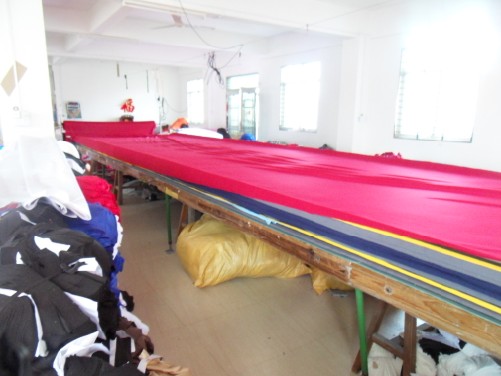
Cutting itself is fast. Once the fabric arrives and passes a four-point inspection, a cutting room spreads, marks and cuts 500 units of a single menswear style in 3–5 days, then bundles the pieces by size and colour for the line. Where cutting does go wrong is upstream: a roll with shading bands, a width shortfall against the marker, or a fabric that arrives 5% shorter than specified forces re-marking and can add a week.
Sewing is where the calendar becomes visible. Take a lined bomber jacket at roughly 45 minutes of standard minute value (SMV) per piece; a basic woven shirt sits near 15 minutes. At 500 units, the jacket represents about 22,500 minutes of sewing — some 375 operator-hours. If 20 operators worked on nothing else at full efficiency, that is around four working days. Real lines carry three to five styles at once, absorb style changeovers, and run at 60–80% efficiency, which is exactly how a mathematically "four-day" job becomes an 18–25 day calendar block.

GorgeousBen's hanging-line sewing floor — 500 pieces of one style typically run across 18–25 calendar days.
Two buyer-side habits shorten this block without paying for overtime: confirming size breakdown early so the line can be balanced before the first bundle arrives, and freezing the tech pack so the pattern is not revised mid-run. Every mid-run change resets the learning curve on the line.
Weeks 8–9: Inline QC, Finishing, and Packing

Packing area at GorgeousBen — final AQL inspection, pressing and export cartons in the last week of the schedule.
Inline inspection should run throughout sewing, not after it. Pieces are checked at the first bundle, at the halfway point and at final assembly, so a systematic fault — a twisted collar, a misaligned placket, a wrong zipper pull — is corrected on 20 pieces instead of 500. The last two weeks add measurement verification against the spec sheet, thread trimming, pressing, hangtag and polybag, carton packing with shipping marks, and a final AQL 2.5 inspection before the container is booked. Documents follow: packing list, commercial invoice, and the certificate of origin or any inspection certificate your market requires.
Even a perfectly run factory cannot absorb buyer-side changes made late. These are the five most common ones and what they cost in calendar days:
| Buyer-side change | Typical added time |
|---|---|
| Late lab dip or Pantone approval | +5–7 days |
| Fit revision after the pre-production sample | +10–14 days |
| Late label, hangtag or artwork files | +5–7 days, or an idle sewing floor |
| Quantity change after fabric is booked | +2–3 weeks |
| Late shipping instructions or forwarder nomination | No production delay, but storage and re-handling charges |
Planning backwards from a launch date is the practical fix: take the ship date, subtract 45–60 days, then subtract your own approval time. GorgeousBen Fashion is a menswear manufacturer with 20+ years of OEM/ODM experience, producing jackets, shirts, trousers and casual wear for wholesale and private-label programmes with no visible branding on the garment. To check timing for your sizes, colours and quantities, send our team your tech pack or browse the product catalogue before you commit to a delivery date.
Frequently Asked Questions
How long does it take to manufacture 500 units of clothing?
Expect 45–60 days from deposit to ship date for a standard 500-unit menswear order: 15–25 days for fabric and trims, 7–10 days for the pre-production sample, 3–5 days of cutting, 18–25 days of sewing, and a final week of inspection, finishing and packing. Stages overlap, so the total is shorter than the sum. In peak season, add one week.
Does a smaller order of 100 units take less time?
Only slightly. Fabric booking, sample approval and line changeover dominate the schedule and do not shrink with quantity, so 100 units typically run 35–50 days rather than 45–60. The genuine saving of a small order is cash and inventory risk, not calendar time. Cutting and sewing compress by roughly one week, while the mill and sample stages stay fixed.
Can a factory rush a 500-unit order?
Sometimes, by 10–15 days, but only in the stages a factory controls. A mill will not dye fabric faster for a small order without a surcharge, while adding a second shift or a dedicated line for cutting and sewing is realistic. Expect a rush premium of 10–25% on labour and a written agreement that the shortened schedule depends on your approvals arriving on time.
When should I place an order for a spring retail launch?
Work backwards and add buffer. For a launch on 1 March, plan a ship date in mid-January, place the order in late November or early December, and approve lab dips and the pre-production sample within the first three weeks. Chinese New Year falls in January or February and shuts mills and sewing floors for two to four weeks, so orders intended to ship in Q1 must be booked before mid-December.