A fabric test report is readable in five minutes once you know four numbers: GSM for weight, a shrinkage percentage, a colour fastness grade from 1 to 5, and a pilling grade from 1 to 5. A 180 gsm knit with 4-5 fastness and under 5% shrinkage is sound; anything outside those bands deserves questions before you approve bulk cutting.
Buyers receive these reports at two moments — when a new fabric is proposed, and when a bulk lot is verified — yet many sign them off without reading, because the pages look like laboratory wallpaper. They are not. Each column is a prediction of how your garments will behave in a warehouse, in a wash and in a customer review. Here is what each one means and where the honest thresholds sit.
Column 1: GSM — The Weight That Sets Everything Else
GSM (grams per square metre) is the fabric's weight, and it anchors price, drape and warmth at once. Typical bands: t-shirts 160–200, hoodies and sweatshirts 280–400, shirting 100–140, trousers 220–320. The number to challenge is not the band itself but the tolerance — a serious supplier states GSM as a target with a tolerance of roughly ±5%. A report that quotes a single bare number with no tolerance is a report to question, because fabric weight drifting 8% downward on a bulk lot is quietly cheaper fabric and heavier garments hanging out of shape.
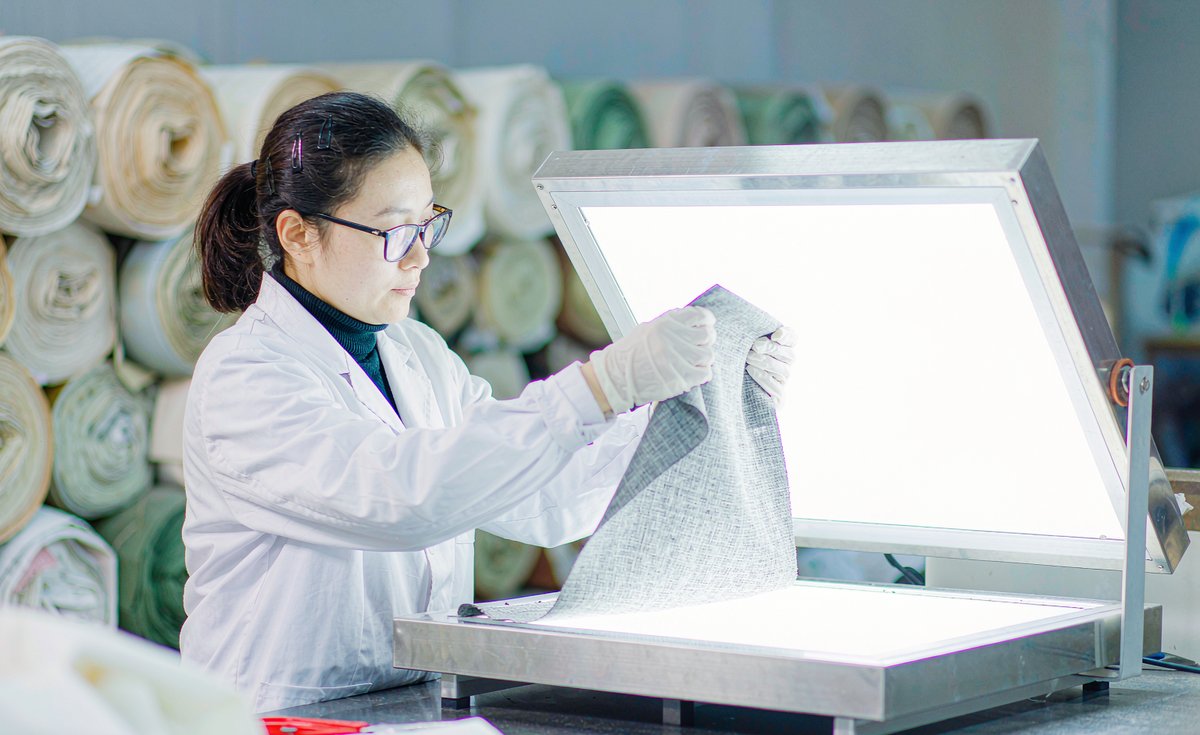
Every roll's weight can be checked against the stated GSM band.
Column 2: Shrinkage — The Number That Decides Your Size Chart
Shrinkage is measured by washing a marked sample under a standard cycle and re-measuring. Well-finished knits commonly land within ±3% to ±5%; anything beyond that pushes your size chart into fiction — a size M that measures true when packed and comes out short after the customer's first wash. Two lines matter here: the raw percentage and the direction. Length-wise and width-wise shrinkage should both be reported; a fabric that shrinks 5% in length and 1% in width will twist seams, not just shorten hems.
What you want to see: both directions within the agreed band, tested after a standard wash, not "expected" values from the mill's datasheet.
Shrinkage is measured on marked samples — never assumed from a datasheet.
Column 3: Colour Fastness — Grades 1 to 5, Not Marketing Adjectives
Colour fastness is graded on a scale from 1 (severe bleeding) to 5 (no change), and reports usually cover several stresses: washing, rubbing (crocking, tested dry and wet), light and sometimes perspiration. For apparel, grade 4 or better on washing and wet crocking is the practical expectation; grade 3 or below on a dark garment predicts faded seams and dye marks on lighter layers worn over it.
Read the sub-columns rather than the headline. A fabric can pass wash fastness and still fail wet rubbing — which is exactly the failure mode that shows up as colour transfer onto a customer's white sofa.
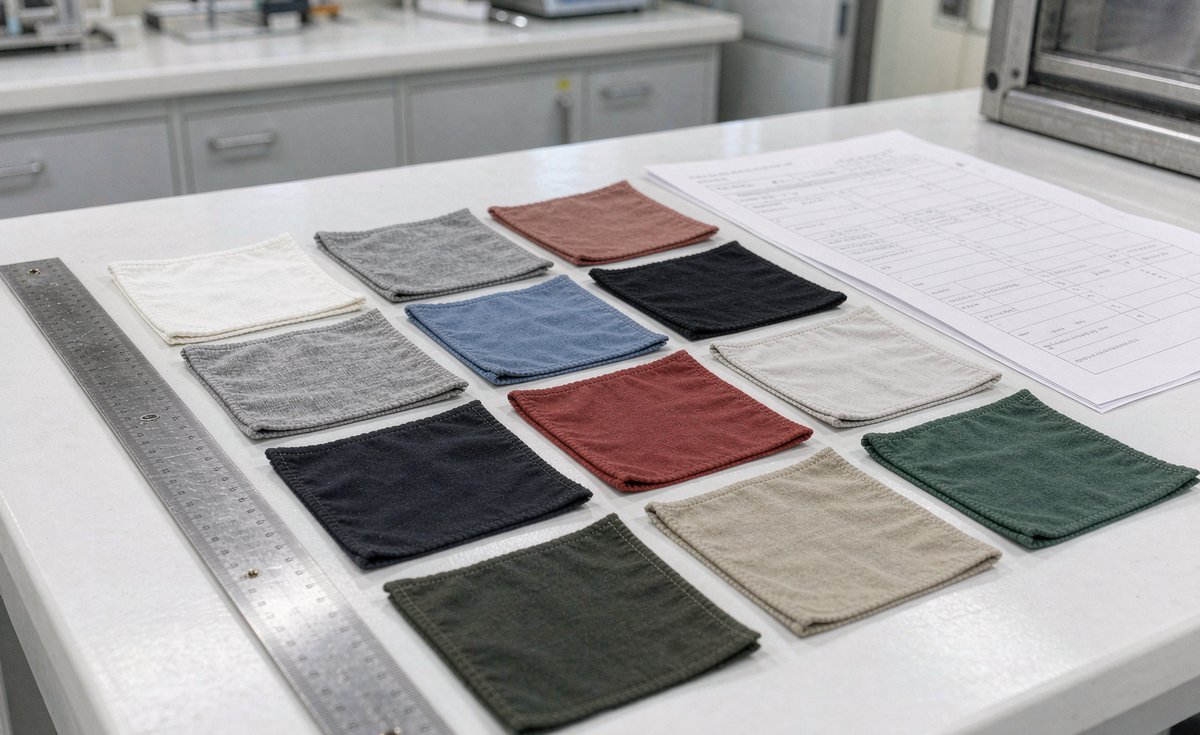
Swatch wall or lab report: colour is judged against standards, not memory.
Column 4: Pilling — Grade 1 to 5 Against a Visual Standard
Pilling is graded against photographic standards after a standard number of rubbing cycles, again 1 to 5. Grade 3-4 or better is a reasonable target for knits that will see regular wear; grade 2 and below on a premium garment is a red flag, because pilling is the defect customers photograph for reviews. Note that staple-fibre fabrics pill more than long-fibre ones — the grade matters more than the promise.
Putting the Four Numbers Together
| Column |
What it predicts |
Typical acceptable band |
| GSM |
Weight, drape, cost |
Target ±5% |
| Shrinkage |
Size chart accuracy |
±3% to ±5%, both directions |
| Colour fastness |
Wash and rub durability |
Grade 4+ (washing, wet crocking) |
| Pilling |
Surface appearance over time |
Grade 3-4+ for regular-wear knits |
A report is one layer of assurance, not the whole system — numbers describe the submitted sample, while the bulk rolls arriving weeks later still need a visual pass on the cutting table, which is where the 4-point inspection system earns its keep. Fabric sits at the centre of nearly every quality claim a factory makes, which is why at GorgeousBen fabric data travels with every quotation — and the product catalogue states the GSM band of each piece up front.
Frequently Asked Questions
What GSM should my fabric be?
It depends on the garment: 160–200 gsm for t-shirts, 280–400 for hoodies, 100–140 for shirting, 220–320 for trousers. Choose within the band for your season and price point, then hold the supplier to a ±5% tolerance on bulk.
Is 5% shrinkage acceptable?
It is the commonly agreed outer limit, not a target. Within ±5% in both directions, a factory can pre-compensate the patterns; beyond it, or with a large length-width imbalance, expect fit complaints after the first wash.
What colour fastness grade is good enough?
Grade 4 or better for washing and wet rubbing on everyday apparel. Grade 3 is defensible only for specific effects or inner layers; grade 2 and below should stop an approval.
Who pays for fabric testing?
For a new development, the factory usually absorbs routine in-house tests; third-party laboratory reports are typically quoted as a line item. For bulk verification on an ongoing program, most buyers prefer to pay for the third-party check themselves — independence is the point.


