You can verify a garment manufacturer at Canton Fair in 15 minutes by testing six things a trading company cannot fake: the business licence scope, monthly capacity in pieces, in-house process coverage, sample construction read from the inside, the name of the person who signs quotations, and the paperwork that follows the shipment.
Phase 3 of the 140th session runs from 31 October to 4 November 2026 at Pazhou in Guangzhou, five days for textiles and apparel, and the booth that looks polished is not automatically the booth that owns a sewing line. What goes wrong after a trade fair is rarely price. It is the discovery, six weeks into a programme, that the “factory” was a three-person trading office, that the sample came from a workshop nobody visited, and that the person who promised the lead time had no authority to promise anything. GorgeousBen, a menswear manufacturer in Shishi, Fujian with more than 20 years of OEM and ODM experience, exhibits during the apparel phase and watches the same 15-minute conversation decide the outcome.
Why Fifteen Minutes Is Enough
Fifteen minutes is not enough to audit a factory, but it is enough to decide whether a booth deserves the next step. Factories answer the same questions with numbers, names and processes; intermediaries answer with adjectives, ranges and “we will confirm by email”. Give every booth identical treatment and the comparison becomes mechanical rather than intuitive.
| Minutes |
Checkpoint |
What a factory shows |
| 1–3 |
Legal identity and address |
Business licence whose scope includes manufacturing, matched to a factory address |
| 4–7 |
Capacity and process coverage |
Monthly output in pieces, number of lines, named in-house processes |
| 8–11 |
Sample construction |
Clean inside seams, consistent stitch density, bartacks at stress points |
| 12–15 |
Quoting authority and paperwork |
A named merchandiser who can commit price, MOQ and lead time, plus export documents |
Minutes 1–3: The Legal Identity Test
Start with the licence, not the line sheet. Ask to photograph the business licence and read three fields: the registered company name, the business scope and the registered address. The name must match the booth signage and the quotation you will later receive; a mismatch usually means you are talking to an agent trading under someone else’s credentials. The scope should include manufacturing or production, not only wholesale, retail or import and export.
Then look at the address. A factory address sits in an industrial zone or garment town, and satellite imagery shows long roofs and loading yards. An office-tower address is not disqualifying on its own, since many factories keep a city sales office, but it must be paired with a production address you can name. Ask the exhibitor to write both on the back of a business card; the hesitation is the answer.
Minutes 4–7: Capacity in Pieces, Not Adjectives
Every booth claims capacity. Very few state it in the unit that matters. Ask for monthly output in pieces for your specific category — cargo pants, casual jackets, woven shirts — and for the number of sewing lines behind that figure. A single line typically produces a few thousand pieces a month on a simple style and far fewer on a multi-pocket construction, so the answer should change when you change the product. If the number stays identical across categories, it is a brochure figure.
Follow with process coverage: cutting, sewing, washing, printing, embroidery and packing. Ask which happen in the company’s own buildings and which are subcontracted to partner workshops. Subcontracting is normal in this industry and not a defect; subcontracting that is hidden is the defect. A factory that maps its supply chain in a booth conversation usually controls quality at each hand-off.
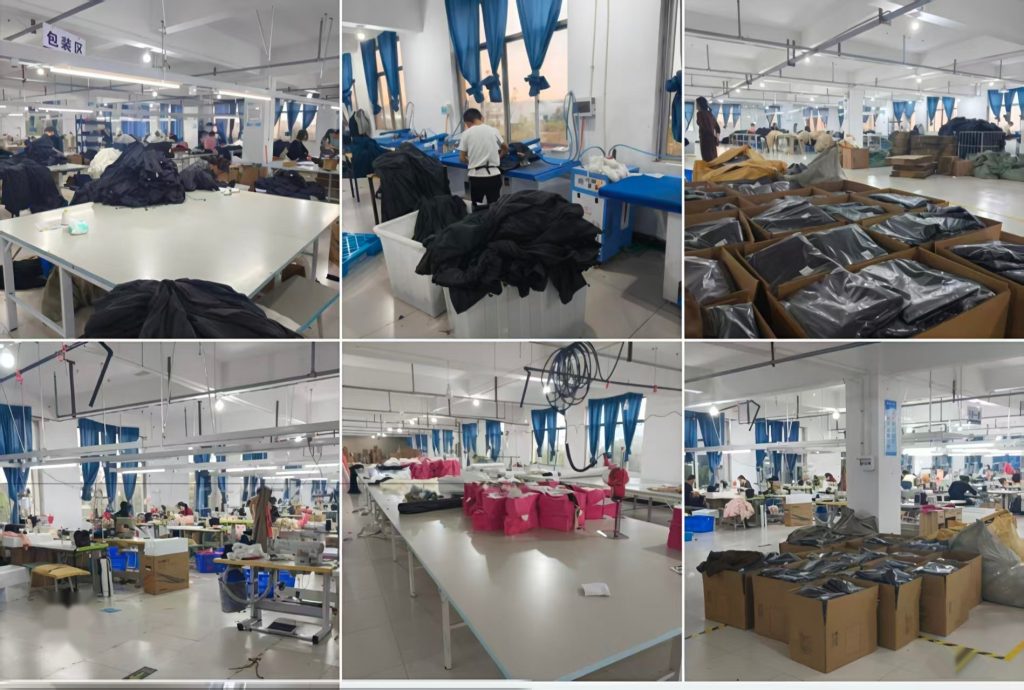
A packing floor with carton specs and shipping marks in progress is a reliable sign of export routine.
Minutes 8–11: Read the Sample From the Inside
Booth samples are the best-dressed garments in the factory, so judge them on the parts nobody styles for photography. Turn the sample inside out and inspect four things: seam type and seam allowance, stitch density along the side seam, bartacks or rivets at pocket mouths and fly ends, and whether the hem is twin-needle or single. Then check a second colour of the same style — if the hand feel changes noticeably, the “same” fabric is coming from more than one source.
Ask for the same style in three sizes and lay them on top of each other. Grading errors show up immediately as wavy side seams or a collar that grows faster than the body. Read the care label and the fibre-content claim, then ask for the test report behind them. Buyers who want the full field procedure will find it in the clothing factory audit checklist.
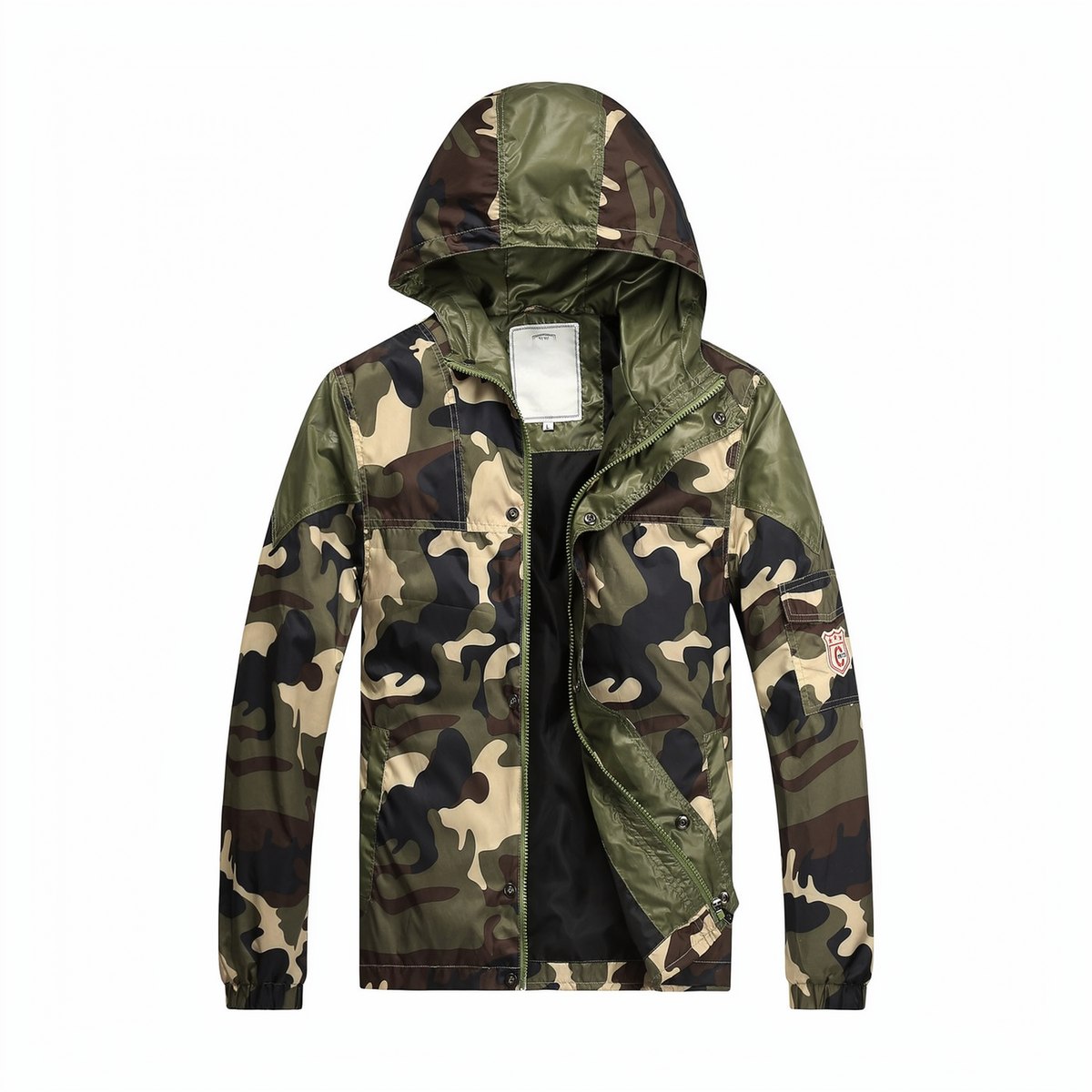
Look at the front for balance and at the inside for seam finishing; the two rarely disagree in a well-run factory.
Minutes 12–15: Who Signs the Quotation?
The last block decides whether the first three meant anything. Three questions, asked in this order:
- Who owns the pattern? A manufacturer develops and holds patterns in-house and can re-cut a fit without a third party. A trader has to ask someone else, and that someone else sets the lead time.
- Who will sign my quotation, and what is their role? Get a name, a job title and a direct contact. If the person you are speaking to cannot commit price, MOQ and lead time, ask to meet the merchandiser or sales manager during the same visit rather than by email in November.
- What happens between order and shipment? Listen for named checkpoints — fabric inspection on arrival, inline inspection during sewing, final inspection before packing — and for who performs each one. An answer that jumps from deposit to delivery is an answer without a quality system behind it.
Add the commercial frame while you are there: MOQ per style and per colour, sample cost and sample lead time, production lead time at your quantity, payment terms and loading port. Record the same fields at every booth that evening; a stack of catalogues is not a shortlist. The preparation side of the visit is covered in how to prepare for Canton Fair garment booths.
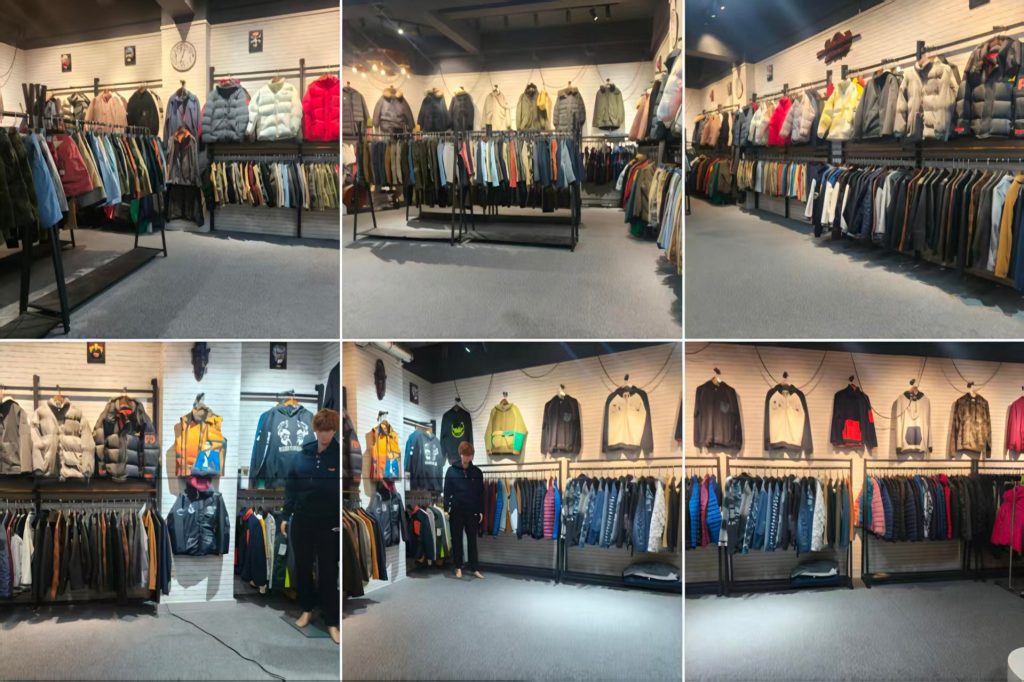
A sample wall shows range; the questions in minute twelve show whether that range can be repeated in bulk.
After the Fifteen Minutes: The Paper Trail That Confirms It
A booth visit is a first interview. Convert it into evidence before any deposit moves, with four requests a genuine factory fulfils without friction: a short video walkthrough of the line that would run your order, the production address written into the proforma invoice, acceptance of third-party inspection before shipment, and a sample round built from your own tech pack. If a supplier resists naming the production address in writing, treat the relationship as unverified.
GorgeousBen receives buyers during the Phase 3 apparel window and works from its own cutting, sewing and packing floors in Shishi. Buyers who prefer to compare styles before travelling can review the GorgeousBen product catalogue and contact the team with target categories and quantities; the meeting details are also set out in Meet GorgeousBen at Canton Fair 2026.
Frequently Asked Questions
How can I tell a factory from a trading company at Canton Fair?
Ask for the business licence and read the business scope and the registered address. A manufacturer’s scope includes production or manufacturing, and the address sits in an industrial zone or garment town. Then ask for monthly output in pieces and the number of sewing lines; a trading company can quote a price but usually cannot describe its own line count, in-house processes or where the pattern is held.
What documents should I ask for at a garment booth?
Request the business licence, the factory address in writing, fabric test reports for the styles you shortlist, and any social-compliance audit certificates the factory holds. Ask for a company profile with the production address rather than a brand brochure. If a supplier cannot produce a test report for a fabric it is quoting, treat the fibre content and weight claims as unconfirmed until a sample round proves them.
Is 15 minutes really enough to qualify a supplier?
It is enough to qualify or eliminate a booth, not to approve a supplier. Fifteen minutes establishes whether the company manufactures, whether its capacity matches your programme, and whether the person in front of you can commit on price and lead time. Approval still requires a sample round, a named production address and, for larger programmes, a factory visit or third-party audit.
Can I visit the factory after Canton Fair?
Yes, and for orders above a few hundred pieces per style it is worth the trip. Shishi in Fujian, where many menswear factories including GorgeousBen operate, is reachable from Guangzhou by high-speed rail in a few hours. Arrange the visit before you fly home, and ask the factory to have your shortlisted styles, fabric swatches and the responsible merchandiser on site that day.


