Clothing factories routinely buy 3–10% more fabric than the marker consumes. That excess — roll ends, offcuts, over-ordered dye lots and cancelled-order stock — is one of the most argued-over items in an apparel purchase order, and it is an asset whose ownership, storage and credit should be settled in writing before the first lay is cut.
Buyers usually discover the gap three ways: the invoice carries fabric above the tech pack, a pallet of short rolls arrives that nobody ordered, or a repeat order is quoted at a new price because the original dye lot is gone. GorgeousBen has made menswear for buyers in 47 countries from its factory in Shishi, Fujian for more than 20 years, and fabric stock is the one line where a written rule costs nothing and a missing rule costs money.
What Counts as Fabric Inventory in a Garment Order
Four different things get called “leftover fabric”, and they carry different costs.
- Allocated bulk fabric. Metres bought against your PO and issued to your cut tickets. Commercially yours, physically in the factory until consumed.
- Over-shipped roll ends. Fabric delivered beyond the order because mills ship full rolls and the last one cannot be cut to an exact length — anything from 5 to 40 metres.
- Offcuts and marker waste. The part of the lay that never becomes a panel. On menswear wovens, marker utilisation commonly falls between 85% and 92%, so 8–15% of the fabric is designed out of the garment before sewing starts.
- Dead stock. Fabric no longer needed after a cancelled style or dropped colour — a commercial decision, covered in our guide to size range planning and wholesale dead stock.
Why Factories Buy More Fabric Than the Order Needs
A quantity that looks generous on an invoice is usually arithmetic rather than padding. Five allowances sit behind it.
- Marker efficiency. Panel shapes do not tile perfectly. A 300-piece order can lose 12–15% of the lay; 5,000 pieces of the same style may hold 6–8% because more sizes nest on one marker.
- Shrinkage and relaxation. Cotton wovens commonly shrink 2–3% in length during industrial washing, and fabric relaxes once unrolled.
- Defect allowance. Not every delivered metre is usable: inspection removes sections with weaving faults, holes or shade bands, as set out in the 4-point fabric inspection system.
- Dye-lot minimums. Dyehouses set a minimum per colour per lot. A buyer needing 400 metres against an 800-metre minimum is offered 800, or a shade that misses the approved lab dip.
- Re-cut allowance. Panels rejected in-line must be replaced from the same dye lot, or the shade difference shows up in the carton.
Read together, 5–10% on a woven menswear order is normal practice, and it belongs on the quotation as a named line rather than folded into a unit price — the entry point for most hidden costs in garment manufacturing. How long that fabric takes to arrive is a separate problem, covered in fabric lead time planning.
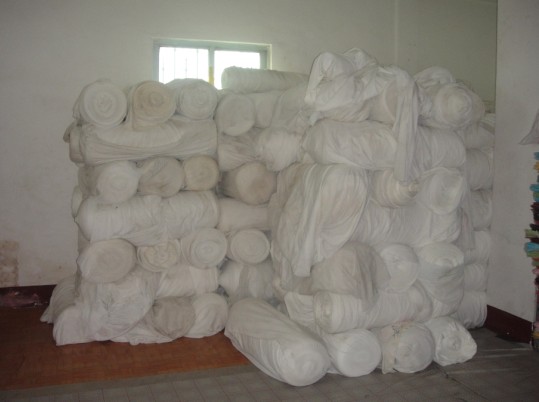
Fabric held by dye lot — the roll register, not the invoice, shows what is really left.
Who Owns the Leftovers? Four Contract Positions
Silence in a purchase order has a default answer, and it is rarely the buyer’s.
| Position in the PO |
What it means |
Who carries the cost |
Works best when |
| No clause (factory keeps) |
Remnants and roll ends stay with the factory, no credit issued |
Buyer pays for fabric it never receives |
Never, unless the value is small and stated |
| Buyer owns all excess |
Every remaining metre is shipped or stored in the buyer’s name |
Buyer pays freight on short lengths |
Premium or licensed fabric you will reuse |
| Residual credited forward |
Excess above an agreed threshold is credited against the next order |
Shared, capped by the credit rate |
Repeat programmes, same fabric |
| Buyer owns, factory stores |
Buyer owns the excess; factory stores it for a fixed number of days |
Buyer pays storage after the window |
Styles likely to be replenished this season |
The clause matters less than naming one: an unstated position resolves in the factory’s favour.
Five Numbers to Agree Before the PO
“Reasonable wastage” cannot be measured, so it cannot be enforced. Agree five figures instead.
- Allowance percentage by fabric type — a 300 g/m² wool melton and a 120 g/m² cotton poplin do not waste the same.
- Remnant threshold in metres, below which a piece stops being a usable roll; often 3–5 metres.
- Storage window — 30 to 90 days is the range we usually see before excess is credited, disposed of or charged.
- Credit rate — at fabric cost, at cost plus handling, or not at all, and on which document it appears.
- Dye-lot rule — how many lots one order may contain, and who absorbs the shade difference if a second is needed.
For repeat programmes the numbers only work if the fabric still exists. Buying from mill stock or dyeing to order changes both the risk and the price, as set out in stock fabric versus custom dyed fabric.
What Actually Happens to Leftover Fabric
Excess in a well-managed factory moves through five destinations, not one bin.
- Next order of the same style — the cheapest outcome, already the right shade, width and hand feel.
- Replenishment stock held for a buyer who reorders within the season, on the PO terms.
- Sampling and trim trials — remnants suit fit samples, colour panels and hardware tests.
- Resale as stock fabric for full rolls of common quality, though recovery is usually a fraction of the purchase price.
- Recycling and rag trade for mixed offcuts below the remnant threshold.
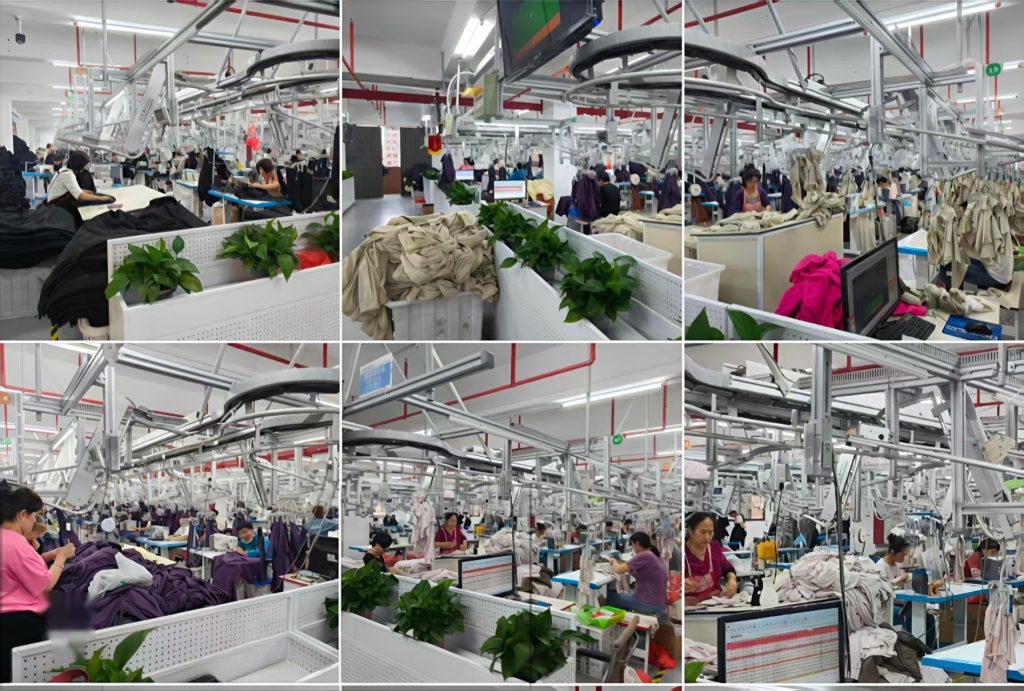
Fabric is issued to a cut ticket, not to a department — that is what makes a metre-by-metre reconciliation possible.
Red Flags: When a Factory Cannot Answer These Questions
Ask about fabric stock before price. Six answers tell you whether inventory is tracked or improvised.
- “How many metres did you receive, and how many have you issued?” No ledger, no reconciliation.
- “Which dye lots are in this order?” A guess here means later shade complaints are not the mill’s fault alone.
- Quotations with no allowance line, fabric quantity folded into a unit price.
- Roll ends nobody can produce when you ask to see them.
- Reluctance to write a remnant threshold or storage window into the PO.
- No consumption report at the end of bulk — usually the numbers were never separated.
How GorgeousBen Handles Fabric Stock
GorgeousBen records fabric by dye lot on arrival, issues it against cut tickets rather than to a department, and keeps a remnant register listing length, shade and location for every piece above the agreed threshold. Buyers on repeat programmes receive a consumption summary at the end of bulk, so the next allowance is based on measured use rather than a fixed guess. Where a buyer takes the residual-credit position, excess above threshold is carried against the following order in writing.
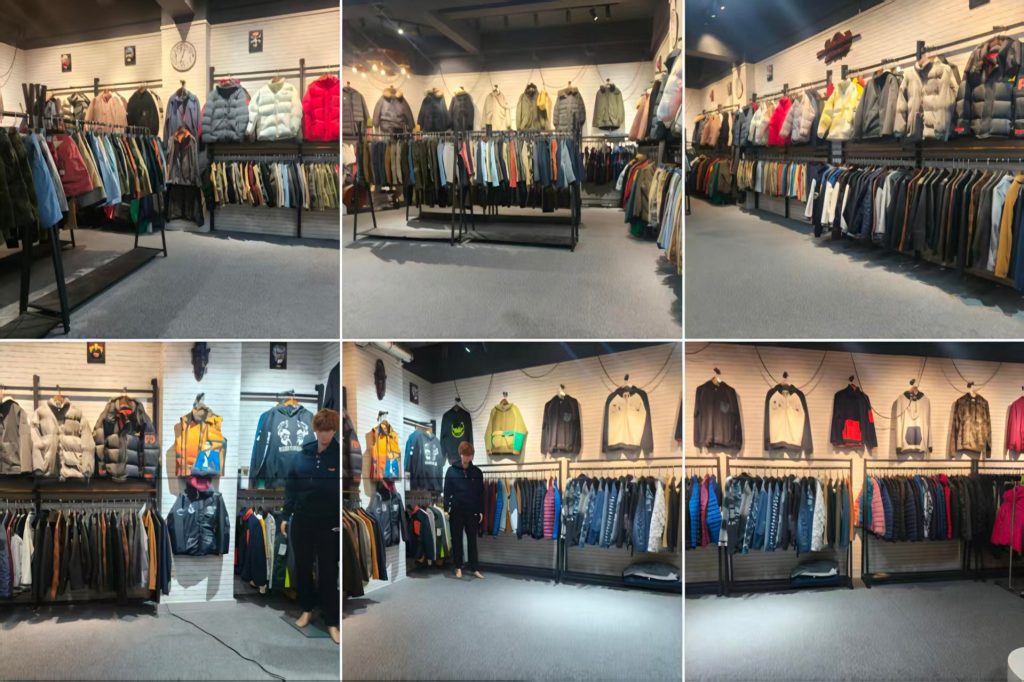
Showroom samples at the GorgeousBen factory in Shishi, Fujian — many built from production remnants.
Frequently Asked Questions
How much extra fabric should a clothing order include?
For woven menswear, a total allowance of 5–10% above the marker requirement is common commercial practice, covering marker waste, shrinkage and re-cut. Small orders sit at the top of that range because fewer sizes nest on one marker, and heavily patterned fabric can exceed it.
Who owns leftover fabric after an order is finished?
Whoever the purchase order says. If the PO is silent the factory keeps the remnants, and the buyer has already paid for them inside the fabric price. The explicit alternatives are buyer ownership with buyer-arranged freight, credit of excess against the next order, and buyer ownership with a fixed storage window.
Can I reuse leftover fabric from a previous order for a new style?
Yes, if the metres come from the same dye lot and cover the marker with allowance. Check the shade against the approved standard in daylight, confirm the width has not changed between lots, and expect a slight difference in hand feel if the fabric was finished in another run. Remnants below the threshold are usually only good for sampling.
Is leftover fabric the same as dead stock?
No. Leftover fabric is physical excess from a production run: roll ends, offcuts and over-shipped metres. Dead stock is fabric or finished goods no longer needed for any planned order, typically after a cancellation or a range change. The first is an accounting question during production, the second a commercial decision after it.
Put the Fabric Rule in Writing Before the First Cut
An allowance without an ownership clause is an open invoice, and a remnant threshold without a storage window is a slow argument. Both cost nothing to settle before cutting and cannot be settled fairly afterwards. GorgeousBen manufactures menswear in Shishi, Fujian and quotes allowance, dye-lot rules and residual handling with the offer. Send your style, quantity and fabric through our contact page, or browse current menswear products to see the programmes we already run.


