Home > Blog > Pattern Making in Garment Manufacturing: A Buyer's Guide
Pattern Making in Garment Manufacturing: A Buyer's Guide
By Ben LeeNovember 23rd, 202622 views
Pattern making in garment manufacturing is the step that turns a sketch and a tech pack into the paper or digital templates every panel of a garment is cut from. A competent first pattern typically takes three to seven working days, and almost every fit, cost and size-consistency problem later traces back to it.
Buyers often blame sewing quality when a sample fits badly — one shoulder higher, an armhole tight, the hem swinging. In practice the sewing line sews what the pattern tells it to. If the pattern is unbalanced, every unit off the line will be unbalanced in the same way. That is why judging a factory's pattern capability before ordering is one of the highest-value checks a buyer can run, and it costs nothing but a few questions.
What a Pattern Is and What a Pattern Maker Does
A pattern is a set of templates — one for every panel of the garment: front body, back body, sleeves, collar, pocket, facing, even the interlining shapes. Each template carries seam allowances, notches, grain lines and construction marks that guide the cutting room and the sewing line. Working from the tech pack and a reference sample, the pattern maker drafts these templates, sews a trial version, and amends the paper until the fit matches the spec.
The work is part engineering, part craft. A good pattern maker thinks in three dimensions while working in two: how a flat sleeve cap will round over a shoulder, how much ease a collar needs to roll without pressing, where the garment will pull once the body bends. Factories that treat this as a clerical task produce garments that measure correctly on the table and still fit badly on a person — because flat measurements alone do not capture balance and ease distribution.
First Pattern vs Production Pattern
Two pattern stages matter to buyers, and mixing them up is a common source of confusion in sampling conversations:
Aspect
First pattern
Production pattern
Purpose
Prove the design and fit on a real body
Cut bulk goods that match the approved sample
Input
Tech pack, sketch, reference garment
Fit-approved sample plus fit comments
Output
Sample-size template set, hand-finished
Digitized, graded, marker-ready template set
Typical timing (common practice)
3–7 working days per style
1–3 working days after fit approval
Who approves
Buyer, on the fit sample
Buyer, against the sealed "golden sample"
The practical takeaway: fit comments must be returned before the production pattern is cut. Comments arriving after bulk fabric is ordered mean either an amendment mid-production or a second sample round — the two most expensive ways to absorb a late comment. Factories that log every amendment, as described in the sample version control guide, make this handover much safer.
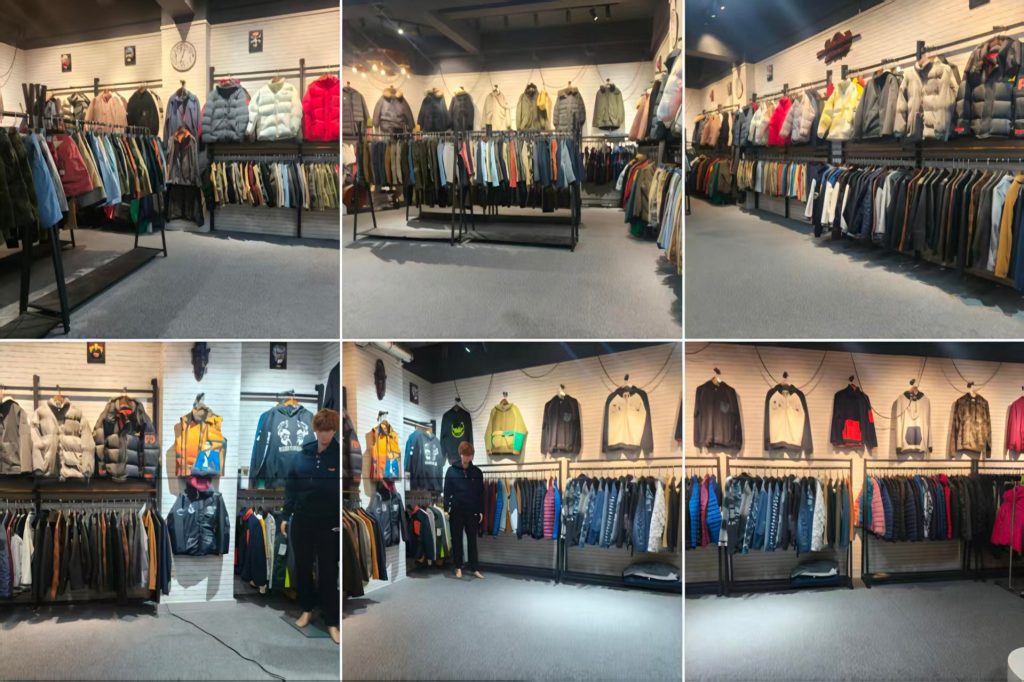
Every garment on this rack started as a template set on paper. Showroom at GorgeousBen, Shishi.
Blocks and Base Patterns: The Factory's Silent Asset
Serious factories build a library of blocks — proven base patterns for a classic shirt, a straight trouser, a crew-neck body — each already tested on real bodies across seasons. New styles are developed from a block rather than drafted from zero, which shortens the first pattern, reduces fit risk on the first round, and keeps the house fit consistent across a product line. A buyer ordering cargo pants from a factory with a strong trouser block starts several steps ahead of one starting from a blank screen.
Blocks also explain why some factories ask detailed questions about the target market and body shape instead of just taking measurements. A block drafted for a European fit and applied to an American size run — or the reverse — produces the familiar complaint that every size "fits like the size below". Asking which block a style will be built on is a fair and revealing question.
How Pattern Quality Shows Up in Cost and Lead Time
Pattern decisions reach the invoice in three ways. First, fabric usage: panels nest on the fabric in a layout called a marker, and a well-shaped pattern nests more tightly. Marker efficiency commonly lands between roughly 80 and 90 percent depending on the style (illustrative figures — stripes, checks and large panels all lower it), so small pattern improvements compound across thousands of units. Second, sampling rounds: every extra fit round adds roughly one to two weeks, which is why a careful first pattern usually costs less overall than a fast, careless one. Third, grading accuracy: sizes are generated from the production pattern, so errors multiply across the size set instead of staying in one size — the grading process is covered separately in the size grading guide.
This is also where pattern work explains part of the sample pricing buyers often find surprising: the quoted sample price is largely pattern-making labour on a single garment, not the bulk cost multiplied out. Once the pattern exists and is proven, that cost is amortized across the whole order.
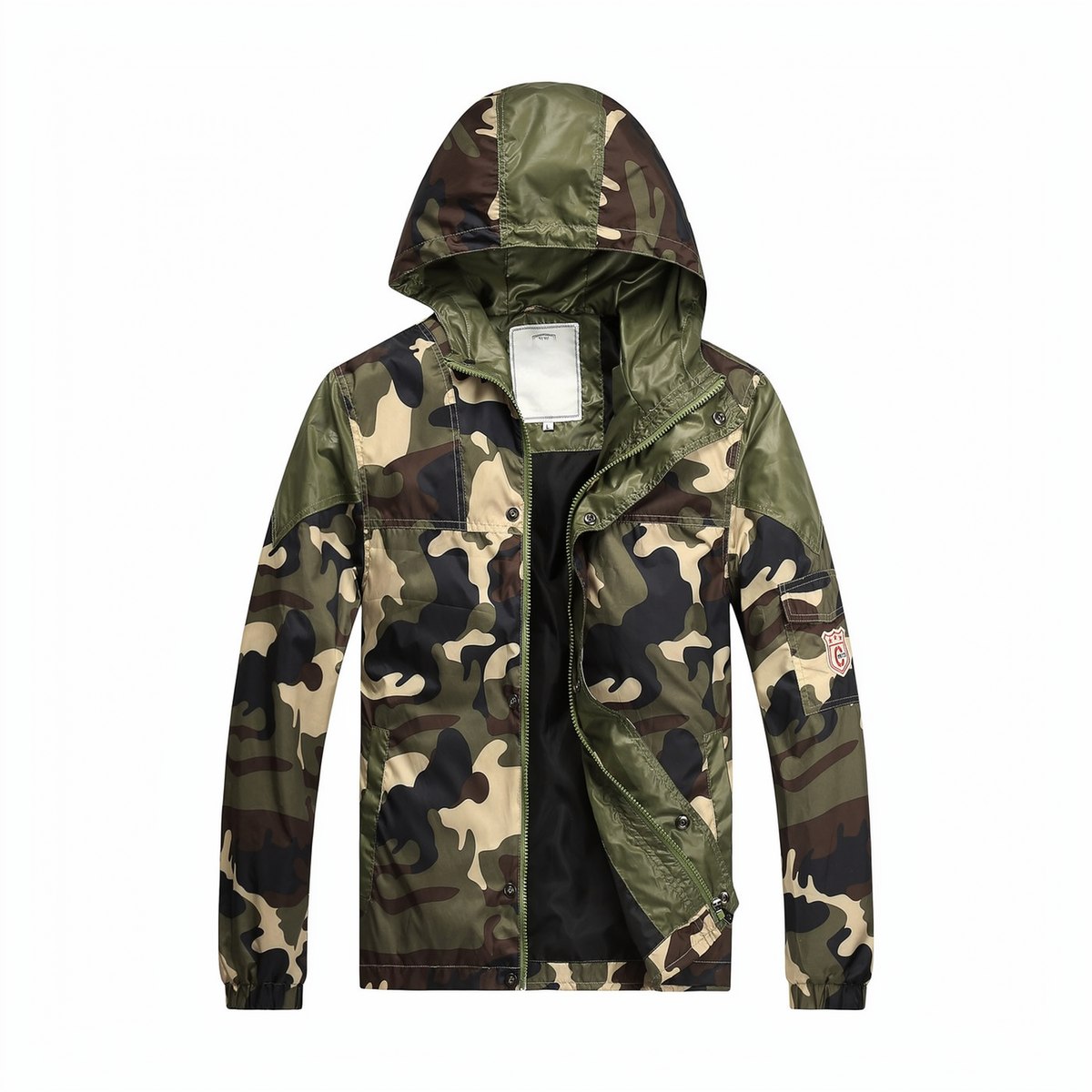
A balanced pattern shows itself in flat form: collar rolls evenly, front edges hang level. GorgeousBen jacket.
A Five-Question Checklist for Judging Pattern Capability
Before committing an order, five questions separate factories that own their patterns from those that outsource and hope:
Are patterns made in-house and kept as digital files? In-house digital patterns mean fast amendments, clean grading and a permanent record; outsourced paper patterns mean every change is slow and lossy.
Which block will this style be built on? A concrete answer referencing a proven base pattern signals experience with the category; a vague answer signals drafting from scratch every time.
How are fit comments recorded and closed? Look for a revision habit — dated comments, amended template, new sample — rather than verbal fixes that evaporate between rounds.
Does the factory measure the garment against the spec before shipping samples? A pattern-checked sample should arrive with a measurement sheet, not just a promise that it fits.
Who owns the pattern files after production? Buyers reordering next season benefit enormously from a factory that keeps their patterns on file — and should agree this explicitly.
None of these questions require technical knowledge to ask. All of them can be answered in a single call or a factory visit, and the answers predict sample behaviour more reliably than a showroom tour.
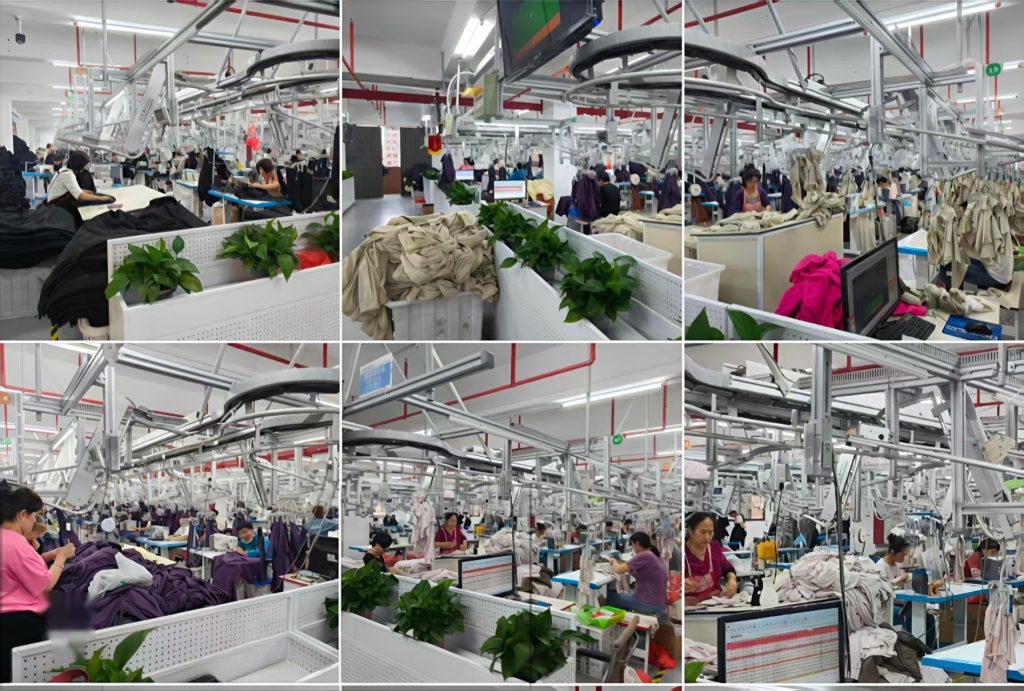
Bulk sewing simply executes the production pattern — which is why pattern quality decides output quality. GorgeousBen hanging line.
Where Patterns Sit in the Wider Workflow
Pattern making sits between paperwork and production: the tech pack feeds it, the sample round proves it, grading multiplies it, and the cutting room executes it. Buyers who understand the handoffs write better comments — a sleeve-length note belongs to the pattern maker, a stitch-density note belongs to the sewing line. When a programme is planned with this sequence in mind, one sample round often suffices; when it is not, three rounds still end in compromise.
The team at GorgeousBen develops menswear patterns in-house on this basis, from first pattern through graded production files, and current jacket, cargo and knit programmes can be reviewed in the product catalogue. Bring a tech pack, a reference sample, or just a target market — the pattern conversation starts from whatever stage the buyer has reached.
Common Questions
How long does pattern making take for one style?
A first pattern commonly takes three to seven working days, depending on style complexity and how complete the tech pack is. After fit approval, converting to a graded production pattern typically adds one to three working days. Complex outerwear with linings and multiple pocket styles sits at the upper end of both ranges.
What is the difference between a pattern and grading?
The pattern is the master template for one size — usually the sample size — containing every panel and construction mark. Grading is the process of mathematically scaling that master into the remaining sizes according to grade rules. A grading error repeats in every unit of that size, while a pattern error repeats in every unit of every size, which is why the master pattern gets the closer review.
Do buyers need to supply their own patterns?
No. Most buyers supply a tech pack and a reference sample, and the factory drafts the pattern from those. Buyers who do have existing patterns — from a previous supplier or an in-house team — should share them, because a proven pattern removes a full round of fit risk. Confirm file formats and ownership terms before sending anything.
What is marker efficiency and why does it matter?
Marker efficiency is the percentage of fabric actually used by pattern panels in the cutting layout; the rest is waste between pieces. Common practice lands around 80 to 90 percent depending on style and fabric — illustrative figures, as stripes, checks and directional prints reduce it. Higher efficiency means less fabric per garment, which flows directly into the FOB price the buyer pays.