Home > Blog > SMV in Garment Manufacturing: How Sewing Cost Is Priced
SMV in Garment Manufacturing: How Sewing Cost Is Priced
By Ben LeeNovember 24th, 20262 views
SMV in garment manufacturing is the Standard Minute Value — the time a trained operator needs to sew one garment at a normal pace, allowances included. A basic five-pocket pant typically carries an SMV of 20 to 25 minutes, while a multi-pocket cargo pant runs 25 to 35 — a gap that shifts labor cost on every single unit.
Buyers rarely see this number, yet it explains most of the spread between quotes. When two factories return FOB prices 30 percent apart for what looks like the same pair of pants, the difference is usually not the fabric — it is how many minutes each factory assumed, at what efficiency, loaded with which indirect costs. This guide explains the term, shows typical ranges, and turns it into a short list of questions that make quotes comparable.
What SMV Actually Measures
SMV — often written as SAM (Standard Allowed Minutes) — is the time-study result for one garment: every sewing operation from joining the first panels to attaching the final label, measured at standard performance. It includes handling time (picking up, aligning, turning) as well as machine time, and it adds allowances for personal needs and minor delays, commonly around 10 to 20 percent on top of pure working time.
Two boundaries matter. First, SMV is defined at a 100 percent performance baseline — a skilled operator at standard pace, no interruptions. Real lines rarely run at 100 percent, which is why efficiency enters the cost formula later. Second, SMV covers sewing assembly only; cutting, pressing, finishing, packing and QC are separate time buckets that factories load on top of it, which is one of the classic hidden costs in garment manufacturing.
Typical SMV Ranges by Garment Type
Ranges vary by construction, but typical figures seen across coastal-China menswear factories look like this (illustrative, sample-based — each factory’s own time study is the authority):
Garment
Typical SMV
What pushes it up
Basic crew-neck tee
5–8 min
Heavy fabric, neck tape, hem operations
Hoodie with kangaroo pocket
15–20 min
Lining, drawcord channel, flatlock seams
Chino / five-pocket pant
18–24 min
Double-needle rows, waistband construction
Cargo pant with bellows pockets
25–35 min
Pocket flaps, bartacks, topstitching passes
Quilted or lined winter jacket
40–55 min
Lining assembly, padding, hardware, closures
The pattern is simple: complexity lives in details, not in garment size. A cargo pocket with a flap and two bartacks can add more minutes than the entire side-seam operation. Buyers comparing a cargo pant against a basic trouser should therefore expect a structural price gap, not a negotiating gap — the cargo pants construction checklist walks through these details piece by piece.
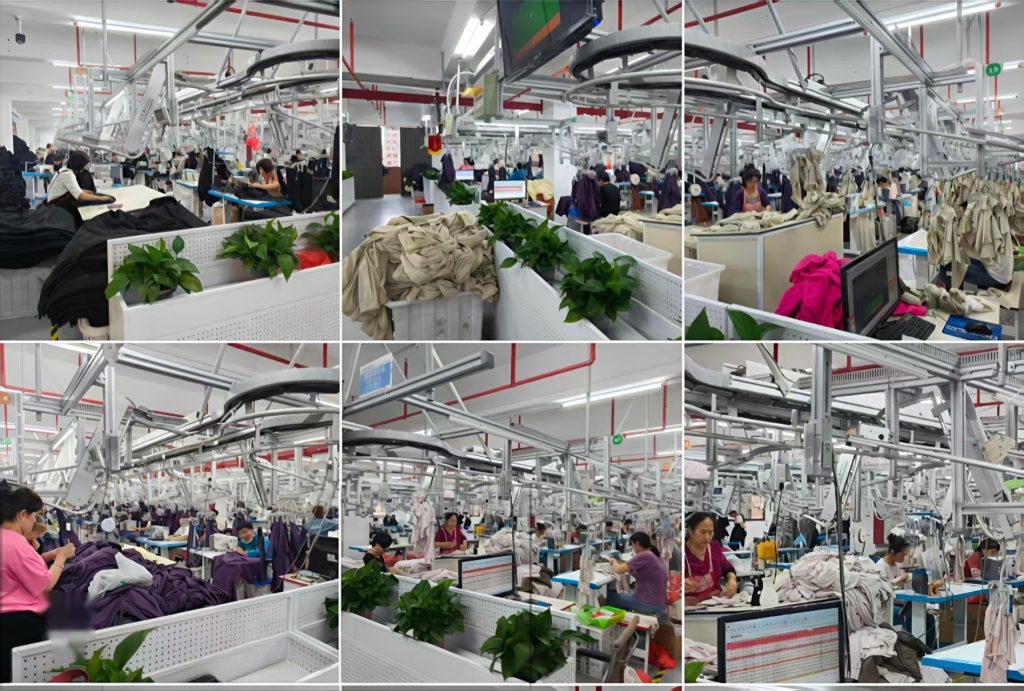
Sewing minutes are made here: a hanging assembly line at GorgeousBen, Shishi, where every station performs one measured operation.
From Minutes to Money: The Three Multipliers
The SMV becomes money through three multipliers, and all three belong inside a serious quote:
The minute rate. The fully loaded cost of one direct operator-minute. As a sample-based reference, coastal-China sewing floors commonly land around US$0.05–0.07 per direct minute, derived from operator wages of roughly ¥6,000–7,500 per month — verify against your own factory.
Planned efficiency. Real lines run at roughly 60–85 percent of the standard, depending on style balance, batch size and changeover frequency. At 70 percent efficiency, a 30-minute garment absorbs about 43 real minutes.
The indirect loading. Cutting, finishing, pressing, QC, supervision and overhead are added on top, commonly 1.5–2.2 times the direct sewing labor figure depending on how the factory allocates them.
A worked example for an olive cargo pant: 30 SMV at US$0.06 per minute is US$1.80 of direct sewing labor; divide by 70 percent planned efficiency and it becomes roughly US$2.60 of real sewing time per unit, before indirect costs are loaded on top. Style questions also move price faster than negotiation: adding a bartack row changes the SMV itself, which multiplies through all three stages. A factory that cannot explain its SMV cannot explain its price — the same logic behind quote price validity clauses.
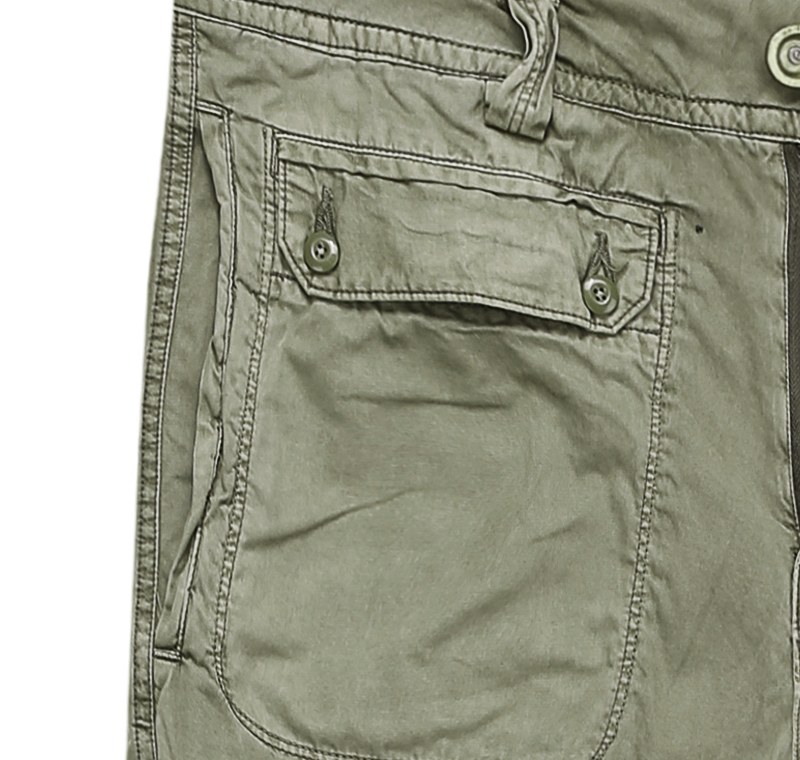
Bellows pockets, flaps and bartacks are where cargo pants accumulate minutes — and where quotes quietly diverge. GorgeousBen cargo detail.
Why Two Quotes on the Same Pants Differ by 30 Percent
None of the causes below are hidden tricks; they are legitimate costing choices that a buyer simply needs to see:
Assumed efficiency. 65 versus 85 percent on a 30-minute garment is six real minutes per unit — visible immediately in the labor figure.
Minute rate and region. Wage levels and loading practice differ between coastal and inland factories, and between owned lines and subcontracted workshops.
Where indirects sit. Some factories fold cutting and finishing into one labor figure; others list them separately, which makes a quick price comparison misleading.
Sample SMV versus bulk SMV. A style first sewn in the sample room carries an inflated SMV; bulk lines with jigs and folder attachments run faster.
Inclusions. Whether thread, labels and packing materials sit inside the sewing price or are quoted separately changes the comparison baseline.
The fix is comparability: ask each factory the same five questions and put the answers side by side.
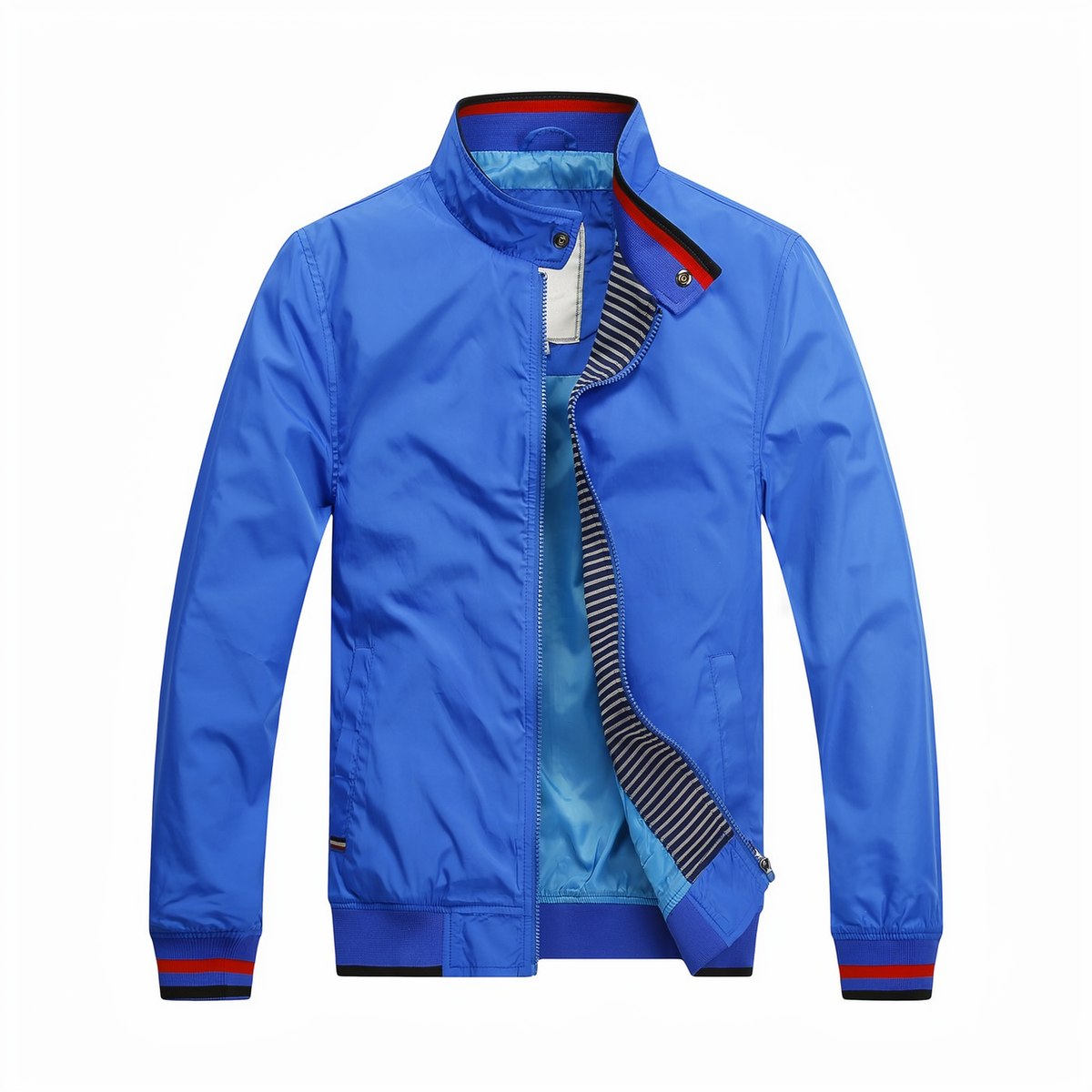
Rows of topstitching are pure measured minutes: each pass adds SMV before a single unit ships. GorgeousBen jacket front detail.
Five Questions That Make Quotes Comparable
May I see the operation breakdown for the three most expensive operations, with minutes per operation? Real numbers signal a real time study; round figures signal a guess.
What planned efficiency have you built into this price, for this style, at this quantity? Efficiency depends on the batch, so the answer should too.
Are cutting, finishing and QC inside this labor figure or listed separately? This single question removes the most common comparison trap.
Is this SMV from your own time study on the sample, or estimated from a similar style? Both answers can be acceptable — as long as you know which one you are paying for.
How many minutes does our proposed change add? An extra bartack row, a flap pocket, a different closure — the answer should arrive in minutes, then in money.
A factory that answers these without hesitation is costing in a controlled way. Evasive or vague answers are themselves information — the same transparency that shows up in a factory’s production capacity answers.
How GorgeousBen Builds Prices From SMV
GorgeousBen prices menswear from an operation breakdown rather than a gut feeling: each style is split into measured operations, the SMV is built up operation by operation, and the multipliers above are stated openly in the quote. When a buyer asks for a change — a pocket style, a bartack row, a different closure — the answer arrives as minutes, not as an unexplained new price. Thread and stitch choices are part of that breakdown too, as described in the sewing thread specification guide.
Current jacket, cargo and knit programmes can be reviewed in the product catalogue. Send a tech pack, a reference sample, or just a target price through the contact page — the costing conversation starts from real minutes, and it works just as well in reverse.
Common Questions
What does SMV stand for in garment manufacturing?
SMV stands for Standard Minute Value: the standard time a trained operator needs to complete one garment or one operation at a normal pace, including allowances. It is the same concept as SAM (Standard Allowed Minutes). Factories use it for line balancing, capacity planning and labor costing — and, read in reverse, it explains most of the labor line in any quote.
What is a typical SMV for cargo pants?
A multi-pocket cargo pant with flaps, bellows pockets and bartacks typically falls between 25 and 35 minutes, against roughly 18 to 24 minutes for a basic five-pocket pant. The exact figure depends on the number of operations, machine types and attachments, so the useful answer is always the factory’s own operation breakdown rather than a generic table.
How do you calculate sewing labor cost from SMV?
Multiply SMV by the direct minute rate, then divide by planned efficiency. For example: 30 SMV × US$0.06 per minute ÷ 0.70 efficiency ≈ US$2.60 of real sewing time per unit. Cutting, finishing and QC are added afterwards, commonly as a 1.5–2.2 loading multiplier — so always confirm what the quoted labor figure already contains.
Does SMV include cutting, finishing and QC?
No. SMV measures sewing assembly only. Cutting, pressing, finishing, packing and inspection are separate time buckets that factories load through a conversion multiplier or list as line items. Because practices differ, two quotes with identical SMV can still carry different total labor costs.
Is a lower SMV always better?
Not necessarily. A lower SMV can reflect simplified construction — fewer bartacks, lighter topstitching, omitted reinforcement — rather than genuine efficiency. Judge SMV together with the specification and QC standards: the right number is the one that matches the agreed construction, not simply the smallest one on the table.